Bài Mẫu Writing Task 1 Dạng Đề Biểu Đồ Cột – Band 8 Mới 2024

Mục lục
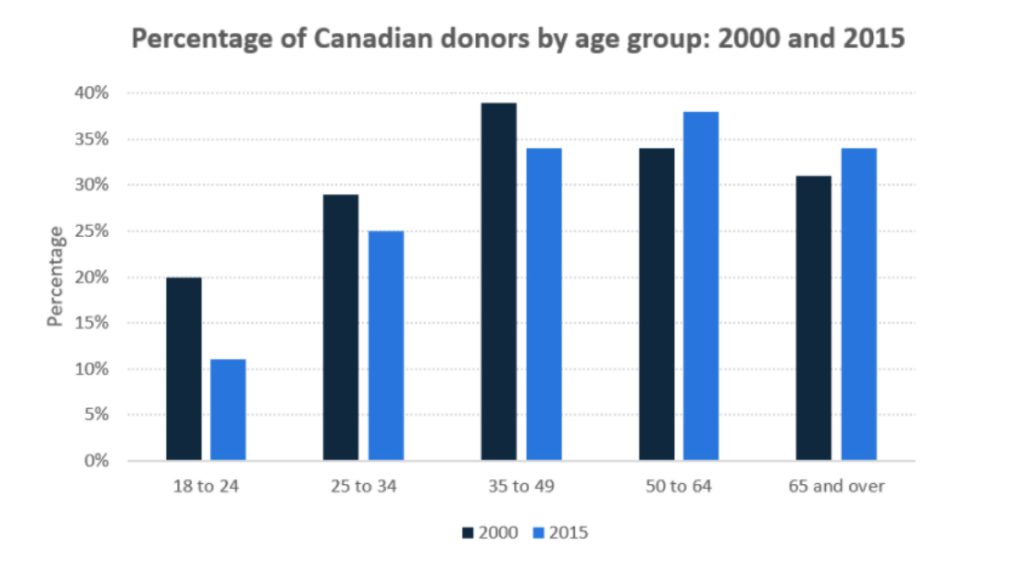
The chart below gives information on the percentage of Canadians gave money to charitable organizations by age range for the years 2000 and 2015.
Summarize the information by selecting and reporting the main features, and make comparisons where relevant.
đề ielts writing task 1 biểu đồ cột

Các điểm thông tin được chọn ra để báo cáo: 

– Tổng quan, tỉ lệ người quyên góp cho từ thiện giảm sau 15 năm

– Người trung niên và cao tuổi đóng góp cho từ thiện nhiều nhất: năm 2000 là nhóm tuổi 35-49, năm 2015 là nhóm tuổi 50-64

– Người trẻ tuổi từ 18-24 đóng góp cho từ thiện ít nhất ở cả 2 năm, và có tỉ lệ giảm phân nửa sau 15 năm

Bài mẫu Writing Task 1 dạng biểu đồ cột hoàn chỉnh

The bar chart provides information regarding the percentage of Canadians who donated money to charity by five different age groups: 18 to 24, 25 to 34, 35 to 49, 50 to 64 and 65 or over, in the year 2000 and 2015. 

Generally, charitable contributions remained at higher levels per capita for the 50-64 and 65 or older groups, while a decrease in donors was seen over the period by those under 50.

In 2000, Canadians aged 35 to 49 had the highest rate of donation at nearly 40%, two times more than the 18 to 24 age group which had the lowest rate at just 20%. Fifteen years later people whose age was 50 to 64 had a slight increase and became the group with the highest donation percentage at about 38%. 

Meanwhile, the ratio of the 18-24 year old who engaged in philanthropic activities dropped sharply to approximately 10%, half of its percentage in 2000 and four times less than people in the 50 to 64 age group’s proportion in 2015. 

(173 words – 20 mins)

>>>>>Tham khảo các khóa học IELTS tại đây.

Dịch song ngữ

Biểu đồ cột này cung cấp thông tin về tỉ lệ người Canada quyên góp tiền cho từ thiện theo năm nhóm tuổi khác nhau: 18 đến 24, 25 đến 34, 35 đến 49, 50 đến 64 và 65 hoặc hơn, trong năm 2000 và 2015.The bar chart provides information regarding the percentage of Canadians who donated money to charity by five different age groups: 18 to 24, 25 to 34, 35 to 49, 50 to 64 and 65 or over, in the year 2000 and 2015. 
Tổng quát, những sự đóng góp cho từ thiện đã giữ nguyên ở mức độ cao trên đầu người cho các nhóm 50-64 và 65 hoặc già hơn, trong khi có thể thấy được một sự suy giảm về số người đóng góp (cho từ thiện) trong khoảng thời gian này với những người dưới 50 tuổi.Generally, charitable contributions remained at higher levels per capita for the 50-64 and 65 or older groups, while a decrease in donors was seen over the period by those under 50.
Trong năm 2000, những người Canada tuổi từ 35 đến 49 đã có tỉ lệ đóng góp cao nhất ở mức gần 40%, nhiều gấp 2 lần nhóm tuổi 18 đến 24, nhóm này có tỉ lệ quyên góp thấp nhất ở chỉ 20%. 15 năm sau, những người có tuổi 50 đến 64 đã có một sự tăng nhẹ và đã trở thành nhóm với tỉ lệ đóng góp cao nhất ở khoảng 38%.Trong khi đó, tỉ lệ người từ 18-24 mà đã có tham gia vào các hoạt động từ thiện đã giảm mạnh xuống còn khoảng 10%, bằng phân nửa tỉ lệ của nhóm này trong năm 2000 và ít hơn 4 lần so với tỉ lệ của nhóm tuổi 50 đến 64 trong năm 2015.In 2000, Canadians aged 35 to 49 had the highest rate of donation at nearly 40%, two times more than the 18 to 24 age group which had the lowest rate at just 20%.Fifteen years later people whose age was 50 to 64 had a slight increase and became the group with the highest donation percentage at about 38%. Meanwhile, the ratio of the 18-24 year old who engaged in philanthropic activities dropped sharply to approximately 10%, half of its percentage in 2000 and four times less than people in the 50 to 64 age group’s proportion in 2015. 

Wordlist – Highlight một số từ vựng trong bài mẫu

  • donor (n): người làm từ thiện, mạnh thường quân
  • donation (v): sự quyên góp
  • charity (n): từ thiện
  • charitable organization (n): tổ chức từ thiện
  • philanthropic activity (n): hoạt động từ thiện, hoạt động thiện nguyện
  • proportion (n) = percentage (n): tỉ lệ
  • contribute (v): đóng góp

Chấm điểm bài viết

Examiner’s scoreTask achievementCohesion & CoherenceLexical rangeGrammar
8888

Để hiểu rõ hơn về các band điểm IELTS Writing, tìm hiểu thêm tại IDP Education.

web giải đề ielts
Tìm hiểu ngay
Bài viết tương tự
Luyện đề IELTS miễn phí
IELTS MOCK TEST LISTENING 11

IPU ACTIVE PRACTICE IELTS Listeningluyện tập chủ động Chọn phần muốn luyện và thời gian phù hợp. Sau khi nộp bài, bạn có thể xem điểm và đối chiếu đáp án ngay trên trang. 01Chọn Part02Nghe & làm bài03Chấm & xem đáp án Thiết lập bài luyện Bài gồm 4 Part, tổng cộng 40 câu. Part 1 · 1–10Part 2 · 11–20Part 3 · 21–30Part 4 · 31–40 Thời gian làm bài 10′20′30′40′ Bắt đầu làm bài → Audio được để trống để bạn tự tải lên và thay đường dẫn sau. IELTS Listening Mock 740 questions A−A+ 🎧 AudioYour browser does not support audio. Điểm của bạn 0/40 Xem đáp ánLàm lại PART 1 QUESTIONS 1 – 10 Questions 1 – 10 Complete the notes below. Write ONE WORD AND/OR A NUMBER in each gap.                                  A conversation about a new school General comment: better than the old school Teachers: – (1)  is a nice person                              HEADMASTER                                                                  – others are more likely to be decent. The French teacher seems to be more native than the (2)  accent SMITH                                        – the school principal's talk mentioned to:                   + (3)  (studying enjoyment, working hard of students) EDUCATION                                        + other things on how to (4)   a good shape,  KEEP                                    which helps you have a better (5)  MOOD Fitness centre:         – the (6)   is bigger than the one at old school POOL                                           – the gym includes everything, i.e., cycling and (7)  machines ROWING Other issues:                  – filming the teachers and students' interviews for their (8) , ARTICLE                               and video project at the main (9)  HALL                                          – they saw Mr. Clark as their former teacher of (10)  subject MUSIC PART 2 QUESTIONS 11 – 20 Questions 11 – 15 Choose the correct letters, A, B or C.                                               London Parks' Introduction 11. What is the first thing that tourists are going to experience at the London Parks Society? enjoying coffee and biscuits during brief history talking listening to a brief talk about the history of some wonderful attractions seeing some famous royal parks in London q12-hide 12. What is True about the "royal park" being built in London? it has a harmonious natural landscape. it was built by members of the royal family. it is replicated all over the UK. q13-hide 13. The Hyde Park is the most famous park in London that covers all of the finest sceneries in London. an area of about 260 hectares and a circumference of 6.5 km. 613 acres, with a 4-mile perimeter. q14-hide 14. The Hyde Park began to construct in 1820s and its design was done by Decimus Burton. in 1536 after King Henry VIII occupied the land from the monks. from 1500s and finished in 1800s. q15-hide 15. The Crystal Palace was  constructed on the Hyde Park site in 1851. used for the Great Exhibition in 1968. used for the Rolling Stones concert in 2010. q16-hide Questions 16 – 20 Which sites in the London Parks Society are suitable for the following descriptions? Choose FIVE answers from the box and write the correct letter, A-G, next to the Questions 16-20. Descriptions of attractive sites: A     the largest park in the UK B     followed Greek architectural design C     the most ancient park of the Royal D     the largest area for outdoor activities E     included the oldest fountain F     located near the Serpentine Lake G    situated in the centre of London List of attractive sites: 16. Grand Entrance: ABCDEFG B 17. Princess of Wales: ABCDEFG F 18. Regent's Park: ABCDEFG D 19. St. James's Park: ABCDEFG G 20. Greenwich Park: ABCDEFG C PART 3 QUESTIONS 21 – 30 Questions 21 – 30 Complete the notes below. Write ONE WORD ONLY in each gap.                                                Video Project on Student Life Enjoyments:    – using the camera (Cristina) – going to a British (21)  HOME Enjoyments:      – contact with students doing other courses by asking some  (Ibrahim)  to have (22)  DINNER Language practice: – listening to instructions (Cristina) – learning (23)  words                                  TECHNICAL Language practice: listening to British students' language because of:                                        (Ibrahim) – normal speed   – a lot of (24)  SLANG Usefulness:     – operating video camera (Cristina) – working with other people:      + learning about (25)  COOPERATING                                     + compromising         + (26)  people who have different views PERSUADING Usefulness:       (Ibrahim) – the importance of (27)  EDITING Future works​:                (Cristina) – decide when

Read More »