
You have approximately 40 minutes to complete this task.
You need to write an essay addressing the topic below:
| Some people think that competition at work, at school and in daily life is a good thing. Others believe that we should try to cooperate more, rather than competing against each other. Discuss both these views and give your own opinion. |
Give reasons for your answer and include any relevant examples from your own knowledge or experience.
Your essay should comprise a minimum of 250 words.
Phân tích dạng đề
Cách đơn giản, hiệu quả để xử lý dạng Discuss 2 views là đồng ý với 1 view và không đồng ý với view còn lại. Mình đồng ý với view nào thì phải cố gắng thuyết phục người đồng thấy nó hợp lý, còn view còn lại mình cần chỉ ra điểm bất ổn, sai trái, thiếu sót của nó.
Bài này chúng mình đồng ý với view 2, tức tin rằng người ta nên hợp tác thay vì tranh đấu.
Phân tích nội dung đề bài
Đề bài yêu cầu mình bàn về hợp tác và tranh đấu trong bối cảnh công sở, trường hợp và đời sống, nên ta cần nói đúng vào các tình huống này.
Cách chọn luận điểm
Sau khi lập dàn ý để tìm hướng đi của bài viết, mình rút ra được 2 luận điểm sau để ủng hộ “collaboration”:
a. “Competition” tuy tạo được chút động lực nhưng dễ dẫn tới mâu thuẫn.
b. “Collaboration” hỗ trợ giải quyết vấn đề mà không kèm nguy cơ chia rẽ các mối quan hệ.
Vầy là ta có 2 luận điểm, mỗi luận điểm làm ý chính của một thân bài.
>>> Xem thêm khóa học IELTS Writing và Speaking.
Cách triển khai ý trong bài
+/ Thân bài 1
Câu 1: Công nhận healthy rivalries có thể có lợi.
Câu 2: Giải thích thêm rằng healthy rivalries thúc đẩy người ta phải thể hiện hết mình để theo kịp người xung quanh.
Câu 3: Đặt ví dụ về healthy rivalries có lợi, như học bổng đại học hay thi đua chốn công sở.
Câu 4: Chỉ ra điểm yếu của rivalries, là rủi ro vượt quá tầm kiểm soát, dẫn tới đố kỵ, ganh ghét.
Câu 5: Khẳng định rằng nếu tình huống xấu như vậy xảy ra thì rivalries trở nên phản tác dụng, vì ảnh hưởng xấu tới công việc, mối quan hệ thay vì củng cố.
+/ Thân bài 2
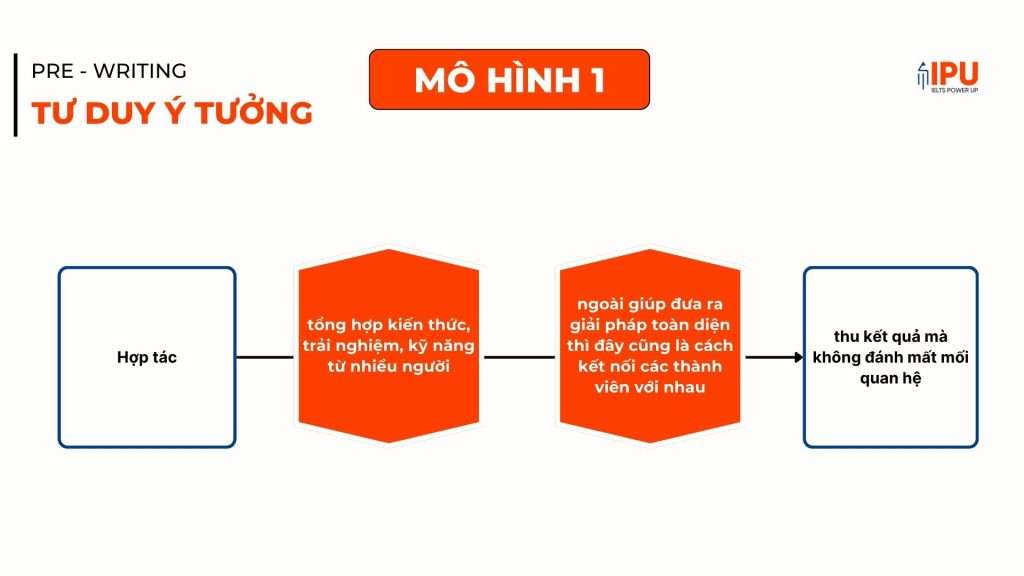
Câu 1: Trong khi đó, cooperation là cách bền vững để thu về kết quả tốt mà không đi kèm rủi ro phá hỏng công chuyện.
Câu 2: Giải thích rõ hơn rằng cooperation giúp đội nhóm tìm ra giải pháp chi tiết, toàn diện hơn vì thu thập từ nhiều ý kiến, kinh nghiệm.
Câu 3: Các giải pháp từ cooperation có thể giải quyết vấn đề triệt để hơn giải pháp từ 1 cá nhân mà chỉ có quan điểm, trải nghiệm phiến diện.
Câu 4: Sự hợp tác cũng khiến người ta hiểu nhau, thân thuộc với nhau hơn, không phá hỏng mà làm mối quan hệ thêm khắng khít.
Câu 5: Đưa ví dụ về cooperation trong công việc và ích lợi rõ rệt của nó trong việc giải quyết tình huống và gia tăng kết nối giữa các thành viên.
Bài viết song ngữ
| The debate regarding whether cooperation or competition is more beneficial in professional, academic, and everyday contexts elicits differing views, with some supporting the former and others advocating the latter. This essay argues in favour of collaboration, for competition carries the risk of escalation into conflict. | Cuộc tranh luận về việc hợp tác hay cạnh tranh có lợi hơn trong các bối cảnh chuyên nghiệp, học thuật và cuộc sống hàng ngày thu hút các quan điểm khác nhau, với một số người ủng hộ phương án trước và những người khác ủng hộ phương án sau. Bài viết này lập luận ủng hộ sự hợp tác, vì cạnh tranh có thể dẫn đến xung đột. |
| Admittedly, healthy rivalries can foster improvement. This is because competitive environments push individuals to constantly perform at their best so as to outperform the others. For instance, limited scholarships to universities encourage high school students to study diligently, excel academically and stand out from their peers, leading to higher grades overall; similarly, a stronger work ethic will be formed as a result of moderate competition in the workplace. However, when the so-called “race to the top” becomes intense, it will likely lead to tension and jealousy, or even outright hostility in the supposedly friendly environment at school, work or everyday life. Such negativity will further exacerbate resentment among peers, eventually becoming counter-productive. | Phải thừa nhận rằng, sự cạnh tranh lành mạnh có thể thúc đẩy sự cải thiện. Điều này là do môi trường cạnh tranh đẩy các cá nhân phải luôn nỗ lực hết mình để vượt trội hơn so với người khác. Ví dụ, số lượng học bổng hạn chế đến các trường đại học khuyến khích học sinh trung học học tập chăm chỉ, xuất sắc về học thuật và nổi bật so với bạn bè, dẫn đến điểm số cao hơn tổng thể; tương tự, một đạo đức làm việc mạnh mẽ sẽ được hình thành do cạnh tranh vừa phải trong công việc. Tuy nhiên, khi cuộc “đua lên đỉnh” trở nên căng thẳng, nó có thể dẫn đến căng thẳng và ghen tị, hoặc thậm chí thù địch trong môi trường vốn dĩ thân thiện tại trường học, nơi làm việc hoặc cuộc sống hàng ngày. Sự tiêu cực này sẽ làm gia tăng sự oán giận giữa các đồng nghiệp, cuối cùng trở nên phản tác dụng. |
| In contrast, cooperation is a more reliable method to get great results without risking relationships. Teamwork allows for more comprehensive resolutions to problems as ideas are gathered from members of diverse backgrounds and skill sets. This collective intelligence could potentially address issues more effectively compared to solutions from a single individual, who only has limited knowledge and possibly biased opinions about certain topics. Furthermore, a collaboration culture at school or at work allows people to better understand one another, further strengthen relationships both professional and familial. An example of this is brainstorming sessions at the workplace, where the free exchange of ideas from different employees expedites the problem-solving process and opportunities to communicate helps people easily bond with each other. | Ngược lại, hợp tác là một phương pháp đáng tin cậy hơn để đạt được kết quả tốt mà không rủi ro đến các mối quan hệ. Làm việc nhóm cho phép giải quyết vấn đề một cách toàn diện hơn khi các ý tưởng được tập hợp từ các thành viên có nền tảng và kỹ năng đa dạng. Trí tuệ tập thể này có thể giải quyết vấn đề hiệu quả hơn so với các giải pháp từ một cá nhân duy nhất, người chỉ có kiến thức hạn chế và có thể có quan điểm thiên vị về một số chủ đề nhất định. Hơn nữa, văn hóa hợp tác tại trường học hoặc nơi làm việc cho phép mọi người hiểu nhau hơn, củng cố thêm các mối quan hệ cả chuyên nghiệp lẫn gia đình. Một ví dụ về điều này là các buổi động não tại nơi làm việc, nơi trao đổi ý tưởng tự do từ các nhân viên khác nhau đẩy nhanh quá trình giải quyết vấn đề và cơ hội giao tiếp giúp mọi người dễ dàng gắn kết với nhau. |
| In conclusion, while competitive context can bring about certain advantages, it also risks creating unwanted disputes or negative emotions. Working as a team is, therefore, more ideal both at school or work. | Tóm lại, mặc dù bối cảnh cạnh tranh có thể mang lại một số lợi thế nhất định, nhưng nó cũng có nguy cơ tạo ra những tranh chấp không mong muốn hoặc cảm xúc tiêu cực. Làm việc theo nhóm, do đó, là lý tưởng hơn cả ở trường học hay nơi làm việc. |
Bài mẫu Writing Task 2 hoàn chỉnh
The debate regarding whether cooperation or competition is more beneficial in professional, academic, and everyday contexts elicits differing views, with some supporting the former and others advocating the latter. This essay argues in favour of collaboration, for competition carries the risk of escalation into conflict.
Admittedly, healthy rivalries can foster improvement. This is because competitive environments push individuals to constantly perform at their best so as to outperform the others. For instance, limited scholarships to universities encourage high school students to study diligently, excel academically and stand out from their peers, leading to higher grades overall; similarly, a stronger work ethic will be formed as a result of moderate competition in the workplace. However, when the so-called “race to the top” becomes intense, it will likely lead to tension and jealousy, or even outright hostility in the supposedly friendly environment at school, work or everyday life. Such negativity will further exacerbate resentment among peers, eventually becoming counter-productive.
In contrast, cooperation is a more reliable method to get great results without risking relationships. Teamwork allows for more comprehensive resolutions to problems as ideas are gathered from members of diverse backgrounds and skill sets. This collective intelligence could potentially address issues more effectively compared to solutions from a single individual, who only has limited knowledge and possibly biased opinions about certain topics. Furthermore, a collaboration culture at school or at work allows people to better understand one another, further strengthen relationships both professional and familial. An example of this is brainstorming sessions at the workplace, where the free exchange of ideas from different employees expedites the problem-solving process and opportunities to communicate helps people easily bond with each other.
In conclusion, while competitive context can bring about certain advantages, it also risks creating unwanted disputes or negative emotions. Working as a team is, therefore, more ideal both at school or work.
309 words
| Score | Task response | Cohesion & Coherence | Lexical range | Grammar |
| 8 | 8 | 9 | 8 |
Wordlist – Từ vựng hay trong bài
elicit (v): gợi lên
escalation (n): sự leo thang
rivalry (n): sự cạnh tranh
foster (v): thúc đẩy
diligently (adv): một cách siêng năng
hostility (n): sự thù địch
supposedly (adv): được cho là
exacerbate (v): làm trầm trọng thêm
resentment (n): sự oán giận
comprehensive (adj): toàn diện
resolution (n): giải pháp
collective (adj): tập thể
familial (adj): thuộc về gia đình
expedite (v): xúc tiến, đẩy nhanh
dispute (n): tranh chấp
>>>> Tìm hiểu các khóa học TESOL tại: https://tse-tesol.edu.vn/




